Mark I Models 1:144 - Page 6

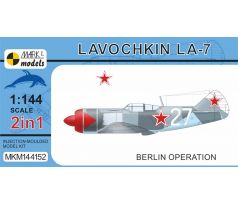
Lavochkin La-7 ‘Berlin Operation’
Two injection-moulded kits are supplied in this box and each kit contains 29 parts and four clear parts (the cockpit canopy, open and closed, and an armourglass panel). A comprehensive decal sheet is included.
Colour schemes included in the kit:
1) Lavochkin La-7, White 27 (c/n 45210127), 176th Guards Fighter Regiment (GIAP), flown by Maj. I.N. Kozhedub, Soviet Air Force (VVS KA), Valga airfield (Estonia, then the USSR), autumn 1944
Lavochkin La-7, White 27 (c/n 45210127), 176th Guards Fighter Regiment (GIAP), flown by Maj. I.N. Kozhedub, Soviet Air Force (VVS KA), Schönwalde airfield, Germany, April 1945
2) Lavochkin La-7, White 14 (c/n unknown), 1st Sq. (АE), 9th Guards Fighter Regiment (GIAP), flown by Maj. A.V. Alelyukhin, Soviet Air Force (VVS KA), Reppen airfield, Germany, April 1945
3) Lavochkin La-7, White 26 (c/n unknown), 137th Guards Fighter Regiment (GIAP), Soviet Air Force (VVS KA), Eggersdorf airfield, Germany, spring 1945
4) Lavochkin La-7 (3-cannon), White 23 (c/n unknown), ‘Mongolskiy arat’, 2nd Sq., 2nd Guards Fighter Regiment (GIAP), Soviet Air Force (VVS KA), Großenhain airfield, Germany, April/May 1945
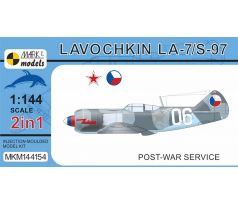
Lavochkin La-7 ‘Post-war Service’
Two injection-moulded kits are supplied in this box and each kit contains 29 parts and four clear parts (the cockpit canopy, open and closed, and an armourglass panel). A comprehensive decal sheet is included.
Colour schemes included in the kit:
1) Lavochkin La-7, White 58 (c/n unknown), 2nd Sq. (AE), 6th Fighter Regiment (IAP), Pacific Ocean Fleet (TOF), Soviet Naval Air Force (VVS VMF), Vtoraya Rechka airfield, Vladivostok, Soviet Union, August 1945
2) Lavochkin La-7, White 06 (c/n 45210806), ‘Gorkovskiy rabochiy’, 2nd Czechoslovak Fighter Regiment, Soviet Air Force (VVS KA), Kraków-Balice airfield, Poland, May 1945
Lavochkin La-7, White 06 (c/n 45210806), ‘Gorkovskiy rabochiy’, 2nd Air Regiment (LP 2), Czechoslovak Air Force, Piešťany airfield, Czechoslovakia, spring 1946
3) S-97 (Lavochkin La-7), s/n S 97-860, White SU-60 (c/n 45210860), 3rd Sq., 44th Air Regiment (LP 44), Czechoslovak Air Force, Vajnory airfield, Czechoslovakia, spring 1948
4) Lavochkin La-7 (3-cannon), White 63 (c/n unknown), 63rd Guards Fighter Regiment (GIAP), flown by A. Maresyev, Group of Soviet Occupation Forces in Germany (GSOFG), Soviet Air Force (VVS USSR), Eggersdorf airfield, Germany, winter 1945/46
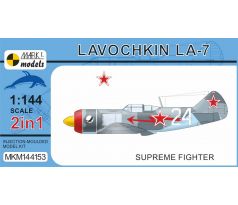
Lavochkin La-7 ‘Supreme Fighter’
Two injection-moulded kits are supplied in this box and each kit contains 29 parts and four clear parts (the cockpit canopy, open and closed, and an armourglass panel). A comprehensive decal sheet is included.
Colour schemes included in the kit:
1) Lavochkin La-7, White 10 (c/n unknown), 4th Guards Fighter Regiment (GIAP), Red Banner Baltic Fleet (KBF), Soviet Naval Air Force (VVS VMF), Lipovo airfield, Soviet Union, autumn 1944
2) Lavochkin La-7, White 63 (c/n unknown), 813th Fighter Regiment (IAP), Soviet Air Force (VVS KA), East Prussia, Germany, winter 1944/45
3) Lavochkin La-7, White 24 (c/n unknown), 3rd Sq. (АE), 9th Guards Fighter Regiment (GIAP), flown by Maj. A-Kh. Sultan, Soviet Air Force (VVS KA), East Prussia, Germany, early 1945
4) Lavochkin La-7 (3-cannon), Black 69 (c/n unknown), unknown Fighter Regiment, Soviet Air Force (VVS USSR), shown on the occasion of the opening of the Park of Culture and Leisure at Leningrad, Soviet Union, 1947
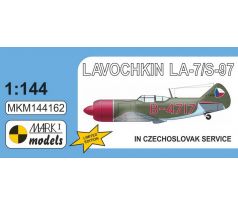
Lavochkin La-7 (S-97) ‘In Czechoslovak Service’
Bagged Edition
This injection-moulded kit (one model is included) contains 29 parts and four clear parts (the cockpit canopy, open and closed, and an armourglass panel). A comprehensive decal sheet is included.
Colour schemes included in the kit:
1) Lavochkin La-7, White 11/4 (c/n 45212611), 2nd Air Regiment (LP 2), Czechoslovak Air Force, Piešťany airfield, Czechoslovakia, spring 1946
2) S-97 (Lavochkin La-7), White JV-8 (c/n 45210813), 2nd Sq., 1st Air Regiment (LP 1), Czechoslovak Air Force, Zvolen (Tri Duby) airfield, Czechoslovakia, autumn 1947
3) S-97 (Lavochkin La-7), Red B-4717 (c/n 45210721), Police Air Patrol Unit (LH) Piešťany, Czechoslovak Police Air Force (Bezpečnostní letectvo), Piešťany airfield, Czechoslovakia, summer 1950
4) Lavochkin La-7 (3-cannon), Grey 09 (c/n 38100965), 2nd Air Regiment (LP 2), Czechoslovak Air Force, seen at Zvolen (Tri Duby) airfield, Czechoslovakia, summer 1946
5) S-97 (Lavochkin La-7, 3-cannon), s/n S 97-465, White PL-02 (c/n 38101465), ground instructional airframe, Anti-aircraft Artillery Training Establishment (PLU), Olomouc, Czechoslovakia, late 1950s
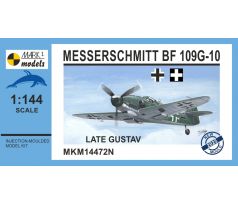
Messerschmitt Bf 109G-10 ‘Late Gustavʼ
Two injection-moulded kits are supplied in this box and each kit contains 27 parts and one clear part (the cockpit canopy). The rear side of the box now comprises the representation of a tarmac section of a military airfield which can be cut out and used as a display base for the assembled model. A comprehensive instruction leaflet and a decal sheet are included.
NOTE: these kits were re-designed and new masters were made. The cockpit canopies were 3D designed and made by injection moulding into a metal mould.
Colour schemes included in the kit:
1) Messerschmitt Bf 109G-10/U4 (WNF-built), Black 21 (W.Nr. 610783), 7./JG 52, Luftwaffe, Neubiberg airfield, Germany, May 1945
2) Messerschmitt Bf 109G-10/R6 (Erla-built), Yellow 11 (W.Nr. 152xxx), JG 52, Luftwaffe, Deutsch Brod airfield, Bohemia-Moravia Protectorate, May 1945
3) Messerschmitt Bf 109G-10/U4 (Diana-built), White 24 (W.Nr. 612762), Jasta 5 d. ROA (Russian Liberation Army) ’Oberst Kazakov’, Fliegerregiment der Luftwaffe der ROA, Deutsch Brod airfield, Bohemia-Moravia Protectorate, March – May 1945
4) Messerschmitt Bf 109G-10/U4 (Diana-built), Yellow 12 (W.Nr. 612769), 101. ’Puma’ Vadászezred (Fighter Regiment), Royal Hungarian Air Force (Magyar Királyi Honvéd Légierő), Veszprém airfield, spring 1945
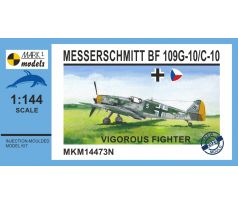
Messerschmitt Bf 109G-10/Avia C-10 ‘Vigorous Fighter’
Two injection-moulded kits are supplied in this box and each kit contains 27 parts and one clear part (the cockpit canopy). The rear side of the box now comprises the representation of a tarmac section of a military airfield which can be cut out and used as a display base for the assembled model. A comprehensive instruction leaflet and a decal sheet are included.
NOTE: these kits were re-designed and new masters were made. The cockpit canopies were 3D designed and made by injection moulding into a metal mould.
Colour schemes included in the kit:
A: Messerschmitt Bf 109G-10 (Erla-built), White 13 (W.Nr. 151567), 10./JG 300, Luftwaffe, Jüterbog-Waldlager airfield, Germany, April 1945
B: Messerschmitt Bf 109G-10/U4 (WNF-built), White 5 (W.Nr. 611048), II./JG 52, Luftwaffe, Neubiberg airfield, Germany, spring 1945
C: Messerschmitt Bf 109G-10/R6 (Erla-built), Yellow 7 (W.Nr. 152016), 3./JG 51, Luftwaffe, Prag-Gbell airfield, Bohemia-Moravia Protectorate, May 1945
D: Avia C-10 (Bf 109G-10), Black EV-12 (c/n 11), SVS Fighter Combat Training Centre, HQ Flt., 2nd Air Division, Czechoslovak Air Force, Planá airfield (České Budějovice), spring 1947
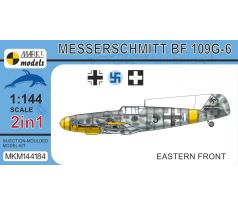
Messerschmitt Bf 109G-6 ‘Eastern Front’
Two injection-moulded kits are supplied in this box and each kit contains 29 parts and one clear part (the cockpit canopy). A comprehensive instruction leaflet and a decal sheet are included.
Colour schemes included in the kit:
1) Messerschmitt Bf 109G-6/R1 (W.Nr. unknown), Gruppenstab of I./JG 51 (Fighter Squadron), Luftwaffe, Orscha airfield, Belarus, the Soviet Union, early 1944
2) Messerschmitt Bf 109G-6 (Erla-built), Black 5, 8./JG 51 (Fighter Squadron), Luftwaffe, Pinsk airfield, Belarus, the Soviet Union, July 1944
3) Messerschmitt Bf 109G-6/trop (Erla-built), MT-416/Yellow 6 (W.Nr. 411704), 3./HLeLv 34 (Fighter Squadron), Finnish Air Force (Ilmavoimat), Kymi airfield, Finland, May 1944
4) Messerschmitt Bf 109Ga-6 (Györ-built), Black V.853 (W.Nr. 95431), 5./101 ‘Puma’ vadászszázad (Fighter Squadron), Royal Hungarian Air Force (Magyar Királyi Honvéd Légierő), Veszprém/Nord airfield, Hungary, summer 1944
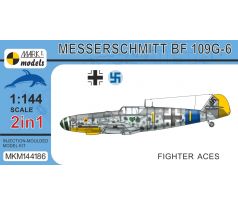
Messerschmitt Bf 109G-6 ‘Fighter Aces’
Two injection-moulded kits are supplied in this box and each kit contains 29 parts and one clear part (the cockpit canopy). A comprehensive instruction leaflet and a decal sheet are included.
Colour schemes included in the kit:
1) Messerschmitt Bf 109G-6/U4 (WNF-built), Yellow 1 (W.Nr. 20499), flown by Lt Erich Hartmann, CO of 9./JG 52 (Fighter Squadron), Luftwaffe, Nove Zaporozhye airfield, the Soviet Union, October 1943
2) Messerschmitt Bf 109G-6/R6 with R3 (WNF-built), White 10 (W.Nr. 140066), flown by Oblt Alfred Grislawski, CO of 1./JG 50 (Fighter Squadron), Luftwaffe, Wiesbaden-Erbenheim airfield, Germany, September 1943
3) Messerschmitt Bf 109G-6/R6 with R3 (WNF-built), Yellow 1 (W.Nr. 440141), flown by Oblt Wilhelm Schilling, CO of 9./JG 54 (Fighter Squadron), Luftwaffe, Ludwigslust airfield, Germany, February 1944
4) Messerschmitt Bf 109G-6/R6 (Mtt-built), MT-453/White 11 (W.Nr. 165274), flown by Staff Sgt Osmo Länsivaara, 1./HLeLv 34 (Fighter Squadron), Finnish Air Force (Ilmavoimat), Taipalsaari airfield, Finland, July 1944
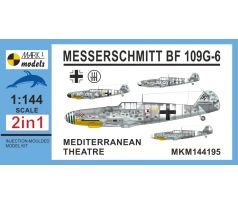
Messerschmitt Bf 109G-6 ‘Mediterranean Theatre’
Two injection-moulded kits are supplied in this box and each kit contains 29 parts and one clear part (the cockpit canopy).
A comprehensive instruction leaflet and a decal sheet are included. The rear side of the box now comprises the representation of a tarmac section of a military airfield which can be cut out and used as a display base for the assembled model.
NOTE: these kits were re-designed and new masters were made. The cockpit canopies were 3D designed and made by injection moulding into a metal mould.
Colour schemes included in the kit:
1) Messerschmitt Bf 109G-6/U4/trop (WNF-built), Yellow 16 (W.Nr. 20xxx), ‘Wunder Zirkus Ubbenʼ, 9./JG 77 (Fighter Squadron), Luftwaffe, Chilivani airfield, Sardinia, Italy, summer 1943
2) Messerschmitt Bf 109G-6/R6/trop (Mtt-built), Yellow 7 (W.Nr. 18068), 6./JG 53 (Fighter Squadron), Luftwaffe, Comiso airfield, Sicily, Italy, spring/summer 1943
3) Messerschmitt Bf 109G-6/U4/R6/trop with R3 (WNF-built), White 8 (W.Nr. 20xxx), 7./JG 27 (Fighter Squadron), Luftwaffe, Maleme airfield, Crete, Greece, 1944
4) Messerschmitt Bf 109G-6/R6 (Mtt-built), White 364-1 (W.Nr. 18391), ‘Gigi Tre Oseiʼ, 364th Flight (364a Squadriglia), 150th Independent Fighter Squadron (150° Gruppo Autonomo), Italian Air Force (Regia Aeronautica, RA), Sciacca airfield, Sicily, Italy, July 1943
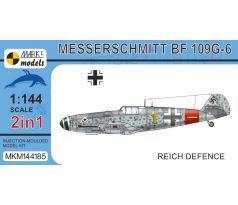
Messerschmitt Bf 109G-6 ‘Reich Defence’
Two injection-moulded kits are supplied in this box and each kit contains 29 parts and one clear part (the cockpit canopy). A comprehensive instruction leaflet and a decal sheet are included.
Colour schemes included in the kit:
1) Messerschmitt Bf 109G-6/R6 with R3 (WNF-built), Yellow 1 (W.Nr. 440190), 6./JG 53 (Fighter Squadron), Luftwaffe, Seyring airfield, Austria, spring 1944
2) Messerschmitt Bf 109G-6/R6 (Erla-built), White 11 (W.Nr. unknown), 7./JG 3 (Fighter Squadron), Luftwaffe, Bad Wörishofen airfield, Germany, early 1944
3) Messerschmitt Bf 109G-6/R3 (WNF-built), White 8 (W.Nr. 140xxx), 1./JG 27 (Fighter Squadron), Luftwaffe, Fels am Wagram airfield, Austria, early 1944
4) Messerschmitt Bf 109G-6/R3 (Erla-built), Black 8 (W.Nr. 26048), 8./JG 54 (Fighter Squadron), Luftwaffe, Ludwigslust airfield, Germany, early 1944
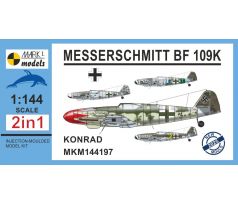
Messerschmitt Bf 109K-4 ‘Konrad’
Two injection-moulded kits are supplied in this box and each kit contains 27 parts and one clear part (the cockpit canopy). A comprehensive instruction leaflet and a decal sheet are included. The rear side of the box now comprises the representation of a tarmac section of a military airfield which can be cut out and used as a display base for the assembled model.
NOTE: these kits were re-designed and new masters were made. The cockpit canopies were 3D designed and made by injection moulding into a metal mould.
Colour schemes included in the kit:
1) Messerschmitt Bf 109K-4, Black 265 (W.Nr. 334265), 1./JG 77, Luftwaffe, Amberg-Schafhof airfield, Germany, April 1945
2) Messerschmitt Bf 109K-4, Blue 16, (W.Nr. 331xxx), 12./JG 27, Luftwaffe, Germany, spring 1945
3) Messerschmitt Bf 109K-4, Black 4 (W.Nr. 332529), Stab JG 52, Luftwaffe, Deutsch Brod airfield, Bohemia-Moravia Protectorate, May 1945
4) Messerschmitt Bf 109K-4, Yellow 2 (W.Nr. unknown), 11./JG 3, Luftwaffe, Pasewalk airfield, Germany, March 1945
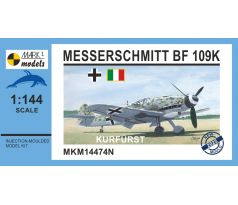
Messerschmitt Bf 109K-4 ‘Kurfürst’
Two injection-moulded kits are supplied in this box and each kit contains 27 parts and one clear part (the cockpit canopy). The rear side of the box now comprises the representation of a tarmac section of a military airfield which can be cut out and used as a display base for the assembled model. A comprehensive instruction leaflet and a decal sheet are included.
NOTE: these kits were re-designed and new masters were made. The cockpit canopies were 3D designed and made by injection moulding into a metal mould.
Colour schemes included in the kit:
A: Messerschmitt Bf 109K-4, White 1 (W.Nr. 330204), 9./JG 77, Luftwaffe, Neuruppin airfield, Germany, November 1944
B: Messerschmitt Bf 109K-4 (Night Fighter), White 5, I./NJG 11, Luftwaffe, Leck airfield, Germany, April 1945
C: Messerschmitt Bf 109K-4, White 12 (W.Nr. 332380), 9./JG 3, Luftwaffe, Pasewalk airfield, Germany, March 1945
D: Messerschmitt Bf 109K-4, 3–14 (W.Nr. 333878), 3rd Flight (3a Squadriglia), 1st Fighter Squadron (I Gruppo Caccia), National Republican Air Force (Aeronautica Nazionale Repubblicana, ANR), Lonate Pozzolo airfield, Italy, March 1945