Harrier GR.3/AV-8A/AV-8C ‘Special Markings’ MKM144119

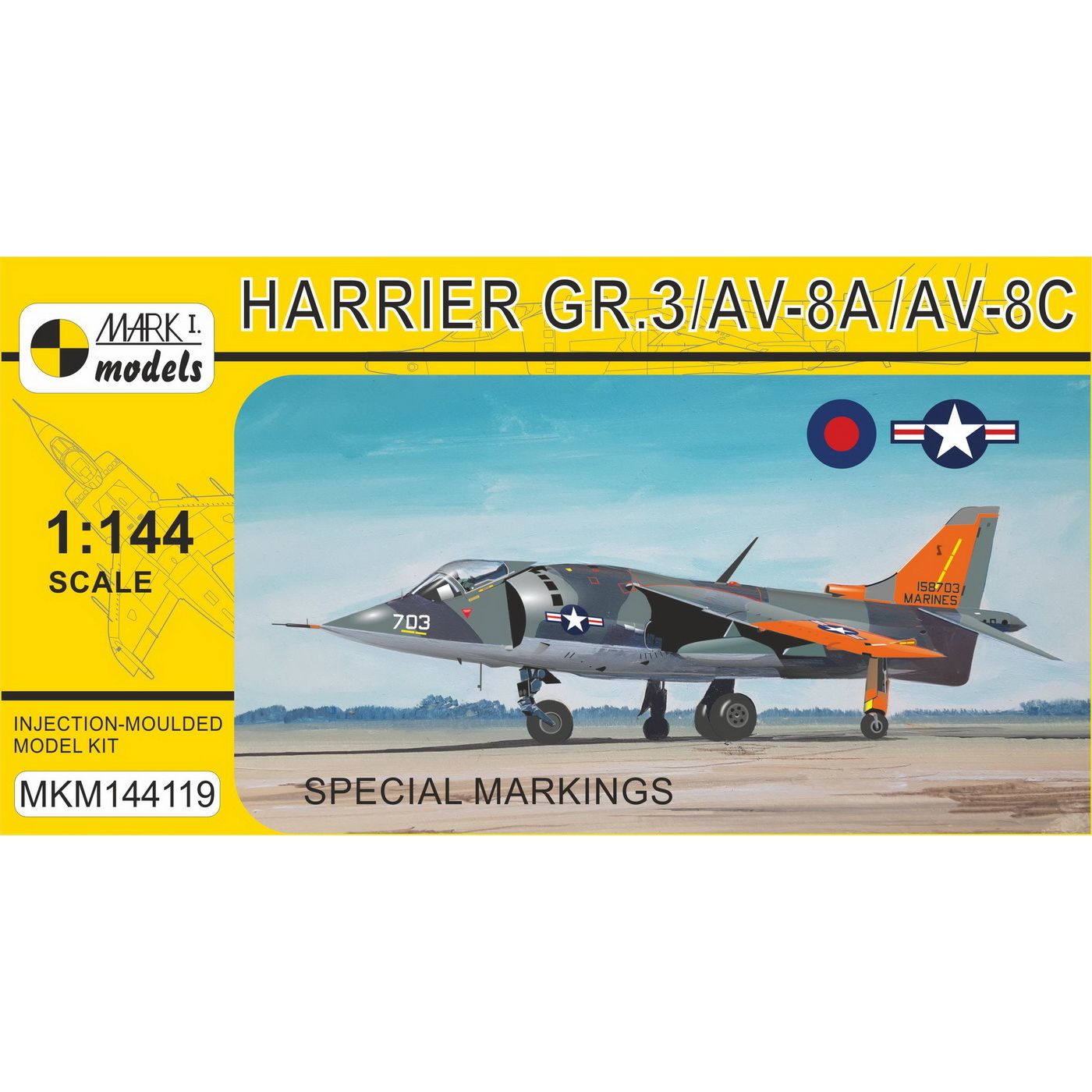

Harrier GR.3/AV-8A/AV-8C ‘Special Markings’ MKM144119
One injection-moulded kit is supplied in this box; it contains 48 parts and one clear part (the cockpit canopy). A comprehensive decal sheet is included.
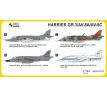
Colour schemes included in the kit:
1) Hawker Siddeley Harrier GR Mk.3, XV738, Grey B, No.4 Sq., RAF, during 'Exercise Match Coat', Gutersloh Air Base, Germany, September 1984
2) Hawker Siddeley Harrier GR Mk.3, XZ129/A2604 (ex-RAF a/c), Black ETS, Engineering Training School (ETS), RN, serving as an instructional airframe, RNAS Yeovilton (HMS Heron), Somerset, U.K., 1992-94
3) AV-8A Harrier (Hawker Siddeley Harrier Mk.50), BuNo 158703, White 703, VMA-513 (Marine Attack Squadron 513) 'Flying Nightmares', US Marine Corps, Sheppard AFB, Texas, U.S.A., April 1980
4) AV-8C Harrier (Hawker Siddeley Harrier Mk.50), BuNo 158387/N719NA, Black 719, National Aeronautics and Space Administration (NASA), Ames Research Center, NAS Moffett Field, California, U.S.A., 1986-1995
| Ref. No.: | MKM144119b |
| Availability: | IN STOCK |
Harrier GR.3/AV-8A/AV-8C ‘Special Markings’ MKM144119
The Hawker Siddeley Harrier "Jump Jet" is a British V/STOL aeroplane developed in the 1960s. The initial version, the Harrier GR.1, was based on the pre-production P.1127 (RAF) fighter, of which a batch of 60 was ordered for the RAF in 1967. A similar model-designated Mk.50, with simplified navigational/attack system, was exported to the United States as the AV-8A, for use by the Marine Corps and a total of 102 aircraft were delivered during the early 1970s. Some 60 aircraft were upgraded as the AV-8Cs by mid 1980s.
The Harrier GR.1/AV-8 was a single-seat fixed-wing all-metal monoplane powered by a R-R Pegasus turbojet (US designation F402), used for ground-attack, close air support, reconnaissance and fighter roles. It was fitted with two air intakes and four vectoring nozzles for directing the thrust generated by the engine. It had a tandem undercarriage and two outrigger landing gear units. External store hard points were installed for carrying a variety of weapons and external fuel tanks: two under each wing and one under the fuselage, while two Aden cannon gun pods could also be fitted beneath the fuselage.
The Harrier was a very innovative aeroplane and the only truly successful V/STOL design of the many that arose during that period of time and it became the versatile warrior of the RAF.
Products purchased together with this product
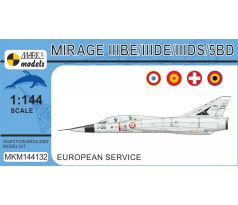
Mirage IIIBE/DE/DS/5BD Two-seater ‘European Service’
This injection-moulded kit contains 45 parts and two clear parts (the cockpit canopy and a landing/taxiing lamp). A comprehensive decal sheet is included.
Colour schemes included in the kit:
1) AMD Mirage IIIBE, c/n 276, Black 2-ZG/276, ECT (Escadron de Chasse et de Transformation) 2/2 ‘Côte d’Or’ (Esc. SPA 65 & SPA 94), French Air Force (Armée de l’Air, AdA), Air Base (BA) 102 Dijon-Longvic, France, 1978
2) AMD Mirage IIIDE, s/n CE.11-26, Black 112-13/CE11-26, Escuadron 112 ‘Rublos’, Ala de Caza 11 (Fighter Wing), Spanish Air Force (Ejército del Aire), Manises Air Base, Spain, 1979
3) Federal Aircraft Works F+W Mirage IIIDS (AMD), c/n 101/228F, Black J-2012, Flieger Staffel 16 (Fighter Sq.), Swiss Air Force (Schweizer Luftwaffe), Buochs Air Base, Switzerland, late 1980s
Federal Aircraft Works F+W Mirage IIIDS (AMD), c/n 101/228F, Grey HB-RDF/ Black J-2012, Fondation du Musée de l’Aviation Militaire de Payerne ‘Clin d’Ailes‘, Payerne Air Base, Switzerland, 2008
4) SABCA Mirage 5BD, c/n 211, White BD 11, 2e Esc. ‘La Comète’, 2e Wing Tactique, Belgian Air Force (Force aérienne belge), Florennes Air Base, Belgium, 1985
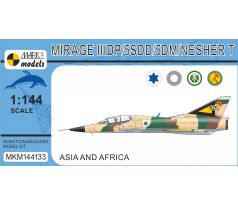
Mirage IIIDP/5SDD/5DM/Nesher T Two-seater ‘Asia & Africa’
This injection-moulded kit contains 46 parts and two clear parts (the cockpit canopy and a landing/taxiing lamp). A comprehensive decal sheet is included.
Colour schemes included in the kit:
1) IAI Nesher T (Vulture), c/n T-05, Black 625, No.144 ‘Defenders of Arava’ Sq. (144 Tayeset), Israeli Air Force (Kheil HaAvir), Etzion Air Base (Bacha 10), Sinai, Israel, 1975
2) AMD Mirage IIIDP, s/n 67-301, Black 301, No.7 (TA) ‘Bandits’ Sq., No.32 (Tactical Attack) Wing, Pakistan Air Force (Pakistan Fiza’ya), Masroor Air Base, Pakistan, 2017-18
3) AMD Mirage 5SDD, c/n 2005, Black 2005, “Royal Saudi Air Force”, a/c purchased by Saudi Arabia on behalf of Egypt for service with the EAF (Egyptian Air Force), AMD plant, Bordeaux-Mérignac Airport, France, 1974
4) Mirage 5DM, c/n 202, Black M202, No.211 Sq., 21st Fighter-Attack Wing, Zaire Air Force (Force Aérienne Zaïroise, FAZ), Kamina Air Base, Zaire, late 1970s
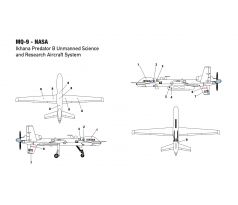
MQ-9 Predator B-NASA
Ikhana Predator B Unmanned Science and Research Aircraft System
Description:
20 Plastic parts
Decals for one Aircraft
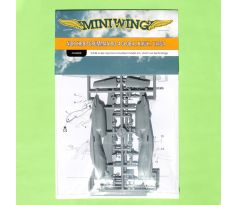
NORTHROP GRUMMAN RQ-4 / NASA
Unmanned surveillance aircraft
Description:
20 Plastic parts
Decals for one Aircraft
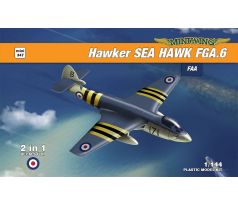
Hawker SEA HAWK FGA.6 FAA
British Carrier Based Fighter / Attacker
Description:
30 plastic parts
2 kits in the box
decals for 3 versions of FAA

