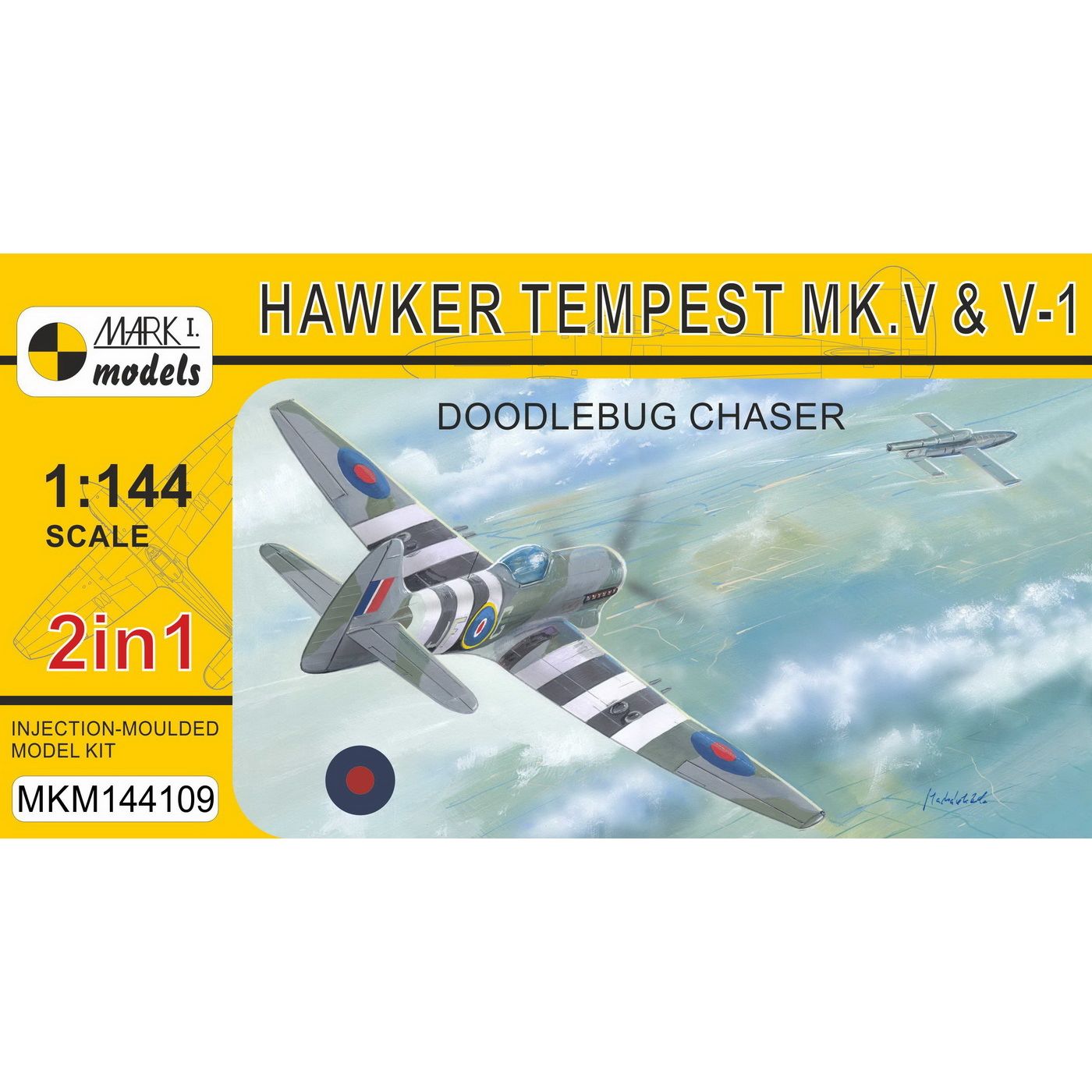
Tempest Mk.V Srs.1/2 + V1 'Doodlebug Chaser' (2in1 + resin)

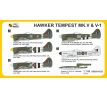

Tempest Mk.V Srs.1/2 + V1 'Doodlebug Chaser' (2in1 + resin)
Description: Two injection-moulded kits are supplied in this box and each kit contains 46 parts and one clear part (the cockpit canopy). A comprehensive decal sheet is included.
A resin kit of the 'Buzz bomb' (produced by Brengun), containing 6 parts, and a display base (made of pasteboard card), depicting grassy field, are added for modeller's convenience.
Colour schemes included in the kit:
1) Hawker Tempest Mk.V (Srs.1), JN751, Sky R-B, No.3 Sq. (flown by W/Cdr R.P. Beamont, OC No.150 Wing), Royal Air Force, Castle Camps airfield, U.K., April 1944
Hawker Tempest Mk.V (Srs.1), JN751, Sky R-B, No.3 Sq. (flown by W/Cdr R.P. Beamont, OC No.150 Wing), Royal Air Force, Newchurch airfield, U.K., June 1944
2) Hawker Tempest Mk.V (Srs.1), JN769, Sky JF-G, No.3 Sq. (flown by F/Lt A.R. Moore, Flt Cdr), Royal Air Force, Newchurch airfield, U.K., June 1944
3) Hawker Tempest Mk.V (Srs.2), JN803, Sky SA-D, No.486 (NZ) Sq. (flown by W/Off J.H. Stafford), 2nd TAF, Royal Air Force, Grimbergen airfield (B-60), Belgium, September 1944
4) Hawker Tempest Mk.V (Srs.2), EJ538, Black SD-R, No.501 Sq., Royal Air Force, Bradwell Bay airfield, U.K., November 1944
| Ref. No.: | MKM144109 |
| Availability: | IN STOCK |
Tempest Mk.V Srs.1/2 + V1 'Doodlebug Chaser' (2in1 + resin)
Hawker Tempest Mk.V series 1/2 'Doodlebug Chaser' (2in1 + resin V-1) (Royal Air Force)
The Hawker Tempest Mk.V was the RAF's last piston-engined fighter used in the WWII, attaining great success in destruction of the German V-1 flying bombs. Developed in late 1941 from the troublesome Typhoon interceptor, the prototype flew in September 1942. The first order was for 400 Tempests, produced as the Mk.V Series 1 (100 a/c by Hawker) and Series 2 (300 a/c by Gloster); the first aircraft were completed in mid-1943. A further two orders for Hawker-built Mk.V Srs.2 aeroplanes raised the total of the Tempests produced to 801.
It was a single-seat monoplane aircraft, of all metal construction, powered by a Napier Sabre II engine. DH or Rotol four-bladed propellers were used. It featured a bubble canopy and a retractable undercarriage. The Srs.1 aircraft had four long-barrelled 20mm Hispano cannons in the wings, while the later Tempests had cannons without projecting barrels. The Srs.2 aircraft could also carry 45-gal drop tanks. In its later guise, the Tempest could perform as a fighter-bomber, carrying a wide variety of bombs up to 1000 lbs. From early 1945 it was cleared for rocket firing and combinations of 25lb or 60lb RP could be carried.
Tempest Mk.Vs were delivered to the RAF and RNZAF squadrons between April 1944 and July 1945, ultimately equipping nine fighter units and one auxiliary squadron. It was the defence of homeland against intruding V-1s that brought about the fate of the Tempest' as a whole they destroyed 36% of all 'Buzz Bombs'. After VE-Day the Tempest Mk.Vs soldiered on with seven squadrons of BAFO in Germany, and the last units retained their aircraft until early 1948.
Products purchased together with this product
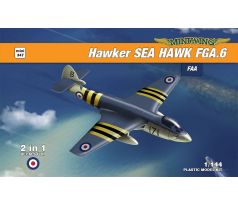
Hawker SEA HAWK FGA.6 FAA
British Carrier Based Fighter / Attacker
Description:
30 plastic parts
2 kits in the box
decals for 3 versions of FAA
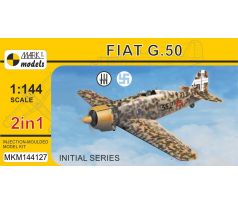
Fiat G.50 'Initial Series' (2in1)
Description:Fiat G.50 'Initial Series' (2in1 = 2 kits in 1 box) Italian AF, Finnish AF
Two injection-moulded kits are supplied in this box and each kit contains 38 parts and one clear part (the cockpit windshield). A comprehensive decal sheet is included.
The Fiat G.50 was an Italian fighter aircraft designed in the mid-1930s, which became the most advanced fighter to be produced in Italy at that time. The prototype flew in February 1937, while the first production aircraft were delivered to the air force two years later.
In the autumn of 1940, an improved version with an extended combat range was introduced and designated the G.50bis. In total, production of the G.50 reached 784 aircraft in seven production series; 426 of which were manufactured by Fiat (Aeritalia) and another 358 were built by CMASA. 58 aircraft were exported: 13 G.50s to Spain, 35 aircraft to Finland and 10 went to Croatia.
It was a single-seat, all-metal low-wing monoplane featuring an open cockpit and a retractable undercarriage. It was powered by a Fiat A.74 two-row radial engine and was fitted with a Hamilton-Fiat propeller. The first versions of the G.50 were fitted with different configurations of armament: either a single or a pair of 12.7mm machine guns in the nose and an additional pair of 7.7mm guns in the wings. The Fiat G.50bis can be distinguished by the redesigned tail, addition of a larger rudder and relocated tail wheel.
The Fiat G.50s were extensively used on various fronts by Italy, including deployment in Belgium, North Africa, in the Balkans, in the Aegean and the Italian mainland. In Finland they served with distinction during the Winter War of 1940 and the Continuation War of 1941a"44 against the Soviet Union.
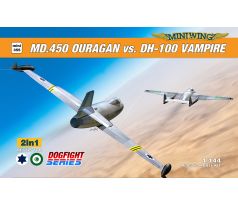
MD.450 OURAGAN vs. DH-100 VAMPIRE
DOGFIGHT SERIES
In the second half of the 1950s, Israeli Ouragans regularly clashed in aerial battles with Egyptian Vampires.
Dassault OURAGAN MD.450
French fighter
23 plastic parts
DH-100 VAMPIRE
British Jet Fighter
31 Plastic Parts
1 Clear Plastic Canopy
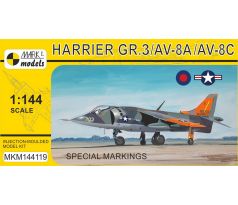
Harrier GR.3/AV-8A/AV-8C ‘Special Markings’ MKM144119
One injection-moulded kit is supplied in this box; it contains 48 parts and one clear part (the cockpit canopy). A comprehensive decal sheet is included.
Colour schemes included in the kit:
1) Hawker Siddeley Harrier GR Mk.3, XV738, Grey B, No.4 Sq., RAF, during 'Exercise Match Coat', Gutersloh Air Base, Germany, September 1984
2) Hawker Siddeley Harrier GR Mk.3, XZ129/A2604 (ex-RAF a/c), Black ETS, Engineering Training School (ETS), RN, serving as an instructional airframe, RNAS Yeovilton (HMS Heron), Somerset, U.K., 1992-94
3) AV-8A Harrier (Hawker Siddeley Harrier Mk.50), BuNo 158703, White 703, VMA-513 (Marine Attack Squadron 513) 'Flying Nightmares', US Marine Corps, Sheppard AFB, Texas, U.S.A., April 1980
4) AV-8C Harrier (Hawker Siddeley Harrier Mk.50), BuNo 158387/N719NA, Black 719, National Aeronautics and Space Administration (NASA), Ames Research Center, NAS Moffett Field, California, U.S.A., 1986-1995
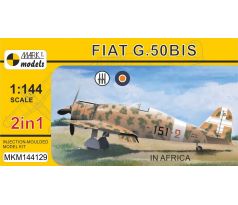
Fiat G.50bis 'In Africa' (2in1)
Two injection-moulded kits are supplied in this box and each kit contains 36 parts and one clear part (the cockpit windshield). A comprehensive decal sheet is included.
Fiat G.50 'In Africa' (2in1 = 2 kits in 1 box) (Italian AF, South African AF)
The Fiat G.50 was an Italian fighter aircraft designed in the mid-1930s, which became the most advanced fighter to be produced in Italy at that time. The prototype flew in February 1937, while the first production aircraft were delivered to the air force two years later.
In the autumn of 1940, an improved version with an extended combat range was introduced and designated the G.50bis. In total, production of the G.50 reached 784 aircraft in seven production series; 426 of which were manufactured by Fiat (Aeritalia) and another 358 were built by CMASA. 58 aircraft were exported: 13 G.50s to Spain, 35 aircraft to Finland and 10 went to Croatia.
It was a single-seat, all-metal low-wing monoplane featuring an open cockpit and a retractable undercarriage. It was powered by a Fiat A.74 two-row radial engine and was fitted with a Hamilton-Fiat propeller. The first versions of the G.50 were fitted with different configurations of armament: either a single or a pair of 12.7mm machine guns in the nose and an additional pair of 7.7mm guns in the wings. The Fiat G.50bis can be distinguished by the redesigned tail, addition of a larger rudder and relocated tail wheel.
The Fiat G.50s were extensively used on various fronts by Italy, including deployment in Belgium, North Africa, in the Balkans, in the Aegean and the Italian mainland. In Finland they served with distinction during the Winter War of 1940 and the Continuation War of 1941a"44 against the Soviet Union.

