Gloster Gladiator Mk.I/Mk.II/J8 Foreign Service


Gloster Gladiator Mk.I/Mk.II/J8 Foreign Service
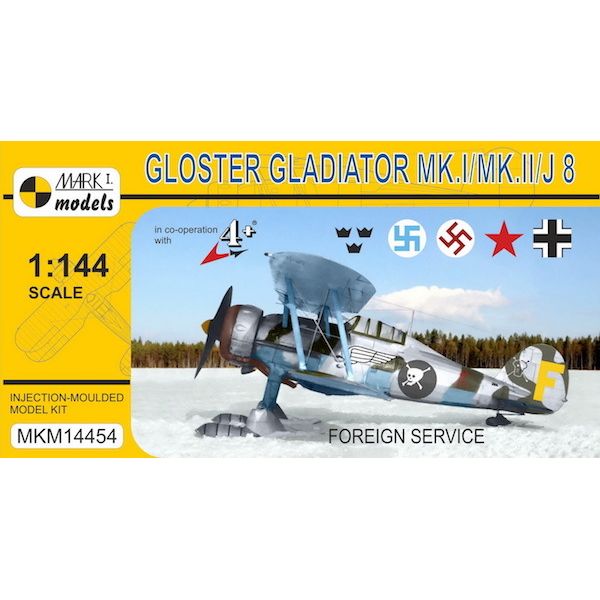
Description: This injection-moulded kit contains 37 parts, four resin part and one clear part (cockpit canopy). A comprehensive instruction leaflet and a decal sheet are included.
Colour schemes included in the kit:
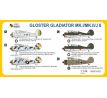
1) J 8 (Gloster Gladiator Mk.I), No.235, Black 8-5, Flygflottilj 8 (Wing F 8), Swedish Air Force, Vasteras airfield, 1937-38
2) J 8A (Gloster Gladiator Mk.II), No.284, Yellow F, Flygflottilj 19 (Swedish Voluntary Wing), Veitsiluoto airfield, Northern Finland, January March 1940
J 8A (Gloster Gladiator Mk.II), No.284, Yellow F (ex-F 19), Swedish Air Force, Barkarby airfield, late March 1940
3) Gloster Gladiator Mk.I, Black 116, 1st Aviation Regiment, Latvian Air Force, Spilve airfield, 1938-39
Gloster Gladiator Mk.I, Black 116 (ex-Latvian a/c), VVS KA (Air Force of the Red Army), Krustpils airfield, the occupied Latvia, summer 1940
4) Gloster Gladiator Mk.I, NJ+BO (W.Nr. 45829), Erg.Gr.(S) 1, Luftwaffe, Langendiebach airfield, Germany, spring 1942
| Ref. No.: | MKM144054 |
| Availability: | IN STOCK |
Gloster Gladiator Mk.I/Mk.II/J8 Foreign Service
Gloster Gladiator Mk.I/Mk.II/J8 Foreign Servicea (Swedish AF, Latvian AF, Soviet AF, Luftwaffe)
The Gloster Gladiator was a British-built biplane fighter developed from the Gauntlet and its prototype, designated the SS.37, flew in September 1934. The first production model was the Mk.I, which became operational in January 1937. An improved Mk.II version followed in 1938 and eventually 270 aircraft of this Mark were built.
The Gladiator Mk.II was a single-seat biplane of metal construction with mixed metal and fabric covering. It was fitted with a fixed undercarriage and powered by a Mercury radial engine turning three-blade metal propeller. Its armament consisted of four guns, of which two were mounted in the fuselage and two under the lower wings.
The Gladiator was the RAFas last biplane fighter aircraft and the first with an enclosed cockpit. Although rendered obsolete by newer monoplane designs, it proved good in initial combats and saw action in almost all theatres during the WWII.
Gladiators (both the Mk.I and Mk.II versions) were successfully exported to many countries and saw service with more than 15 air arms, including those of Belgium, China, Egypt, Finland, Free France, Greece, Iraq, Ireland, Lithuania, Norway and Portugal. They also equipped RAAF and SAAF squadrons in the Middle East and North Africa.
Latvia took delivery of 26 Gladiator Mk.Is while Sweden flew their 55 planes under military designation J 8 and J 8A. A number of ex-Latvian aircraft were captured by the Soviet Union in the summer of 1940 and yet one year later, some of them were seized by invading German Army and made their way to the Luftwaffe training units.
Products purchased together with this product
Bristol Beaufighter Mk.IF 'Night Fighter'
This injection-moulded kit contains 53 parts and six clear parts (cockpit canopies, position lights etc.). A comprehensive instruction leaflet and a decal sheet are included.
Colour schemes included in the kit:
1) Bristol Beaufighter Mk.IF, R2248, Grey WM-S, No.68 Sq., RAF, High Ercall airfield (detachment Valley, Anglesey), autumn 1941
2) Bristol Beaufighter Mk.IF, X7671, Red WP-D, No.89 Sq., RAF, Abu Sueir airfield, Egypt, spring 1942
3) Bristol Beaufighter Mk.IF, T4637, Red NG-O, No.604 Sq., RAF, Middle Wallop airfield, autumn 1942
4) Bristol Beaufighter Mk.IF, V8318, Sky F, No.252 Sq., RAF, El Magrun (Al Maqrun) airfield, Libya, spring 194
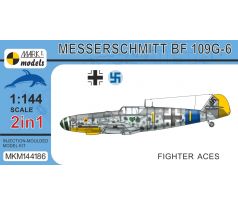
Messerschmitt Bf 109G-6 ‘Fighter Aces’
Two injection-moulded kits are supplied in this box and each kit contains 29 parts and one clear part (the cockpit canopy). A comprehensive instruction leaflet and a decal sheet are included.
Colour schemes included in the kit:
1) Messerschmitt Bf 109G-6/U4 (WNF-built), Yellow 1 (W.Nr. 20499), flown by Lt Erich Hartmann, CO of 9./JG 52 (Fighter Squadron), Luftwaffe, Nove Zaporozhye airfield, the Soviet Union, October 1943
2) Messerschmitt Bf 109G-6/R6 with R3 (WNF-built), White 10 (W.Nr. 140066), flown by Oblt Alfred Grislawski, CO of 1./JG 50 (Fighter Squadron), Luftwaffe, Wiesbaden-Erbenheim airfield, Germany, September 1943
3) Messerschmitt Bf 109G-6/R6 with R3 (WNF-built), Yellow 1 (W.Nr. 440141), flown by Oblt Wilhelm Schilling, CO of 9./JG 54 (Fighter Squadron), Luftwaffe, Ludwigslust airfield, Germany, February 1944
4) Messerschmitt Bf 109G-6/R6 (Mtt-built), MT-453/White 11 (W.Nr. 165274), flown by Staff Sgt Osmo Länsivaara, 1./HLeLv 34 (Fighter Squadron), Finnish Air Force (Ilmavoimat), Taipalsaari airfield, Finland, July 1944
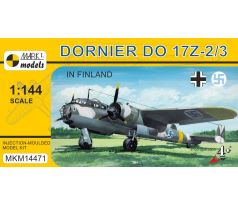
Dornier Do-17Z-2/3 'In Finland'
Description: This injection-moulded kit contains 63 parts and eleven clear parts (the cockpit canopies, rear ventral gunner's window etc.). A comprehensive decal sheet is included.
Colour schemes included in the kit:
1) Dornier Do 17Z-2, CQ+HG (W.Nr. 4187), Luftwaffe, Tampere airfield, Finland, February 1942
2) Dornier Do 17Z-3, White DN-60 (W.Nr. 2818), 1/LeLv 46 (Squadron), Finnish Air Force (Ilmavoimat), Pyhaselka airfield, summer 1942
3) Dornier Do 17Z-3, White DN-64 'Ace of Spades' (W.Nr. 2822), LeLv 46 (Squadron), Finnish Air Force (Ilmavoimat), Helsinki-Malmi airport, April 1943
4) Dornier Do 17Z-3, White DN-52 (W.Nr. 2608), PLeLv 43 (Bomber Sq.), LeR 4 (Flying Regt.), Finnish Air Force (Ilmavoimat), Luonetjarvi airfield, summer 1947
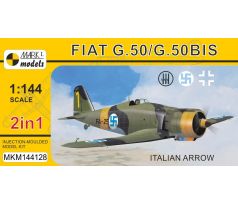
Fiat G.50/50bis 'Italian Arrow' (2in1)
Two injection-moulded kits are supplied in this box and each kit contains 40 parts and one clear part (the cockpit windshield). A comprehensive decal sheet is included.
Description:Fiat G.50/50bis 'Italian Arrow' (2in1 = 2 kits in 1 box) (Italian AF, Finnish AF, Luftwaffe)
The Fiat G.50 was an Italian fighter aircraft designed in the mid-1930s, which became the most advanced fighter to be produced in Italy at that time. The prototype flew in February 1937, while the first production aircraft were delivered to the air force two years later.
In the autumn of 1940, an improved version with an extended combat range was introduced and designated the G.50bis. In total, production of the G.50 reached 784 aircraft in seven production series; 426 of which were manufactured by Fiat (Aeritalia) and another 358 were built by CMASA. 58 aircraft were exported: 13 G.50s to Spain, 35 aircraft to Finland and 10 went to Croatia.
It was a single-seat, all-metal low-wing monoplane featuring an open cockpit and a retractable undercarriage. It was powered by a Fiat A.74 two-row radial engine and was fitted with a Hamilton-Fiat propeller. The first versions of the G.50 were fitted with different configurations of armament: either a single or a pair of 12.7mm machine guns in the nose and an additional pair of 7.7mm guns in the wings. The Fiat G.50bis can be distinguished by the redesigned tail, addition of a larger rudder and relocated tail wheel.
The Fiat G.50s were extensively used on various fronts by Italy, including deployment in Belgium, North Africa, in the Balkans, in the Aegean and the Italian mainland. In Finland they served with distinction during the Winter War of 1940 and the Continuation War of 1941a"44 against the Soviet Union.

