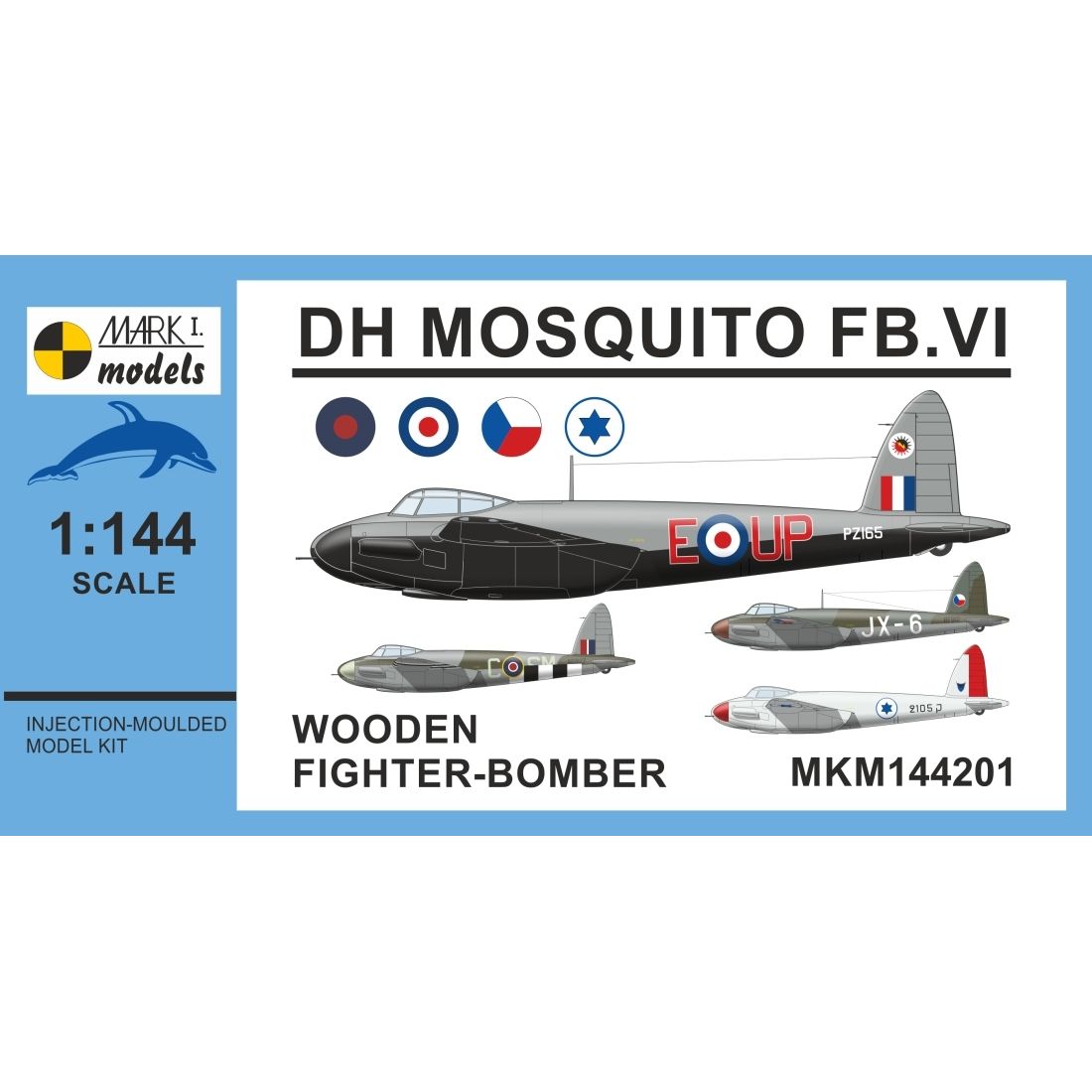
DH Mosquito FB.VI ‘Wooden Fighter-Bomber’

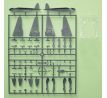

DH Mosquito FB.VI ‘Wooden Fighter-Bomber’
This injection-moulded kit contains 68 parts and five clear parts (the cockpit canopy, wing tips with position lights etc.).
A comprehensive decal sheet is included. The rear side of the box now comprises the representation of a tarmac section of the airfield which can be cut out and used as a display base for the assembled model.
Colour schemes included in the kit:
1) de Havilland DH.98 Mosquito FB Mk.VI (Srs.II), NS927, Sky SM-C ‘Janka Kituś’, No.305 ‘Greater Poland’ Sq., Royal Air Force, Hartford Bridge airfield, Hampshire, U.K., autumn 1944
2) B-36 (de Havilland DH.98 Mosquito FB Mk.VI, Srs.II), RF912, White JX-6, 2nd Sq., 24th Air Regiment, Czechoslovak Air Force, Plzeň-Skvrňany airfield, Czechoslovakia, 1948
3) de Havilland DH.98 Mosquito FB Mk.VI (Srs.II), 2105 (ex-LR303), Black K-2105, No.109 ‘Valley’ Sq., Israeli Air Force (Kheil Ha‘Avir), Hatzor Air Base, Israel, early 1953
4) de Havilland DH.98 Mosquito FB Mk.VI (Met), PZ165, Red UP-E, No.4 Sq., Royal Air Force, British Air Forces of Occupation (BAFO), Celle Air Base, Germany, 1949
| Ref. No.: | MKM144201 |
| Availability: | IN STOCK |
DH Mosquito FB.VI ‘Wooden Fighter-Bomber’
The de Havilland DH.98 Mosquito was a British multi-role combat aircraft developed in 1939. The Mosquito was constructed almost entirely of wood and, as such, it was dubbed “The Wooden Wonderˮ. Originally conceived as an unarmed high-speed bomber, it was later adapted to many other roles, including day-time tactical bomber, night bomber, day or night fighter, fighter-bomber, maritime interceptor and photo-reconnaissance aircraft.
The Mosquito FB Mk.VI was a fighter-bomber (or strike aircraft), which first flew in June 1942 and it went into service in the spring of 1943.
It was a two-seat, twin-engine, mid-wing monoplane, of a composite wood construction, fitted with a retractable undercarriage. The crew was seated under conventional canopy. It was powered by two Merlin in-line engines turning narrow (later “paddle” type) three-bladed propellers. Typical gun armament was four 0.303″ (7.7 mm) Browning machine guns and four 20 mm Hispano cannons, while two 250 or 500lb (110 or 230 kg) bombs could be carried in the bomb bay. A provision was also made for two 50-gal (227 1itre) or 100-gal (454 litre) underwing drop tanks, or two 250lb or 500lb bombs.
In total, 2,298 FB Mk.VIs were built, nearly one third of Mosquito production. In 1942 production was also launched in Canada in Australia. The Canadian version of the Mosquito FB Mk.VI was the FB Mk.21, which was developed into the FB Mk.26 (3 and 338 built, respectively). In Australia the Mk.VIs were built as the FB Mk.40, of which 178 were produced for the RAAF.
The Mosquito flew with the RAF and other air forces in the European and Mediterranean theatres and also took part in overseas conflicts.
Products purchased together with this product
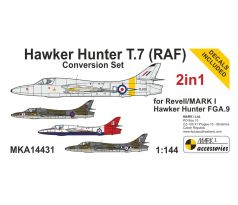
Hunter T.7 (RAF) Conversion Set
Two conversion sets (injection-moulded parts) are included, each containing 14 parts and one clear part (the cockpit canopy).
For modeller’s convenience a display base, made of pasteboard card, depicting tarmac section of the military airport is added.
A comprehensive instruction leaflet and a decal sheet are included.
Colour schemes included in the kit:
1) Hawker Hunter T Mk.7, XL620, No.66 Sq., RAF, Acklington Air Base, Northumberland, U.K., 1960
2A) Hawker Hunter T Mk.7, WV372/R, No.2 Sq., RAF (Royal Air Force Germany, RAFG), Gütersloh Air Base, West Germany, 1967-69
2B) Hawker Hunter T Mk.7, G-BXFI, painted as WV372/R of No.2 Sq., Fox-One Ltd., Kemble Air Base/Cotswold Airport, Gloucestershire, U.K., 2001-11
3) Hawker Hunter T Mk.7, XL619, White 77, No.45 Sq., RAF, Wittering Air Base, Cambridgeshire, U.K., acting as an umpire a/c during ‘Exercise Big Click 74ʼ, Leck Air Base, West Germany, August/September 1974
4) Hawker Hunter T Mk.7, XL612, ‘Raspberry Ripple’, Empire Test Pilotsʼ School (ETPS), Royal Aircraft Establishment (RAE), Boscombe Down Air Base, Wiltshire, U.K., 1970-2001
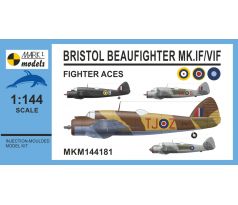
Bristol Beaufighter ‘Aces’
This injection-moulded kit contains 51 parts, 5 resin parts and six clear parts (cockpit canopies, position lights etc.). A comprehensive instruction leaflet and a decal sheet are included. The rear side of the box comprises the representation of a tarmac section of the airfield which can be cut out and used as a display base for the assembled model.
Colour schemes included in the kit:
1) Bristol Beaufighter Mk.IF, X7750, Grey B, No.1435 Flt., RAF, flown by Flt Lt G.L. Hayton, Luqa airfield, Malta, March 1942
2) Bristol Beaufighter Mk.VIF, V8515, Red VA-S, No.125 (Newfoundland) Sq., RAF, flown by Flt Lt G.E. Jameson, Fairwood Common airfield, February 1943
3) Bristol Beaufighter Mk.IF, X7677, Red TJ-Z, No.272 Sq., flown by Flg Off E.E. Coate, RAF, Idku airfield (LG-229), Egypt, July 1942
4) Bristol Beaufighter Mk.VIF, ND220, No.176 Sq., RAF, flown by Sq Ldr J.H. Etherton, Minneriya airfield, Ceylon, April 1945
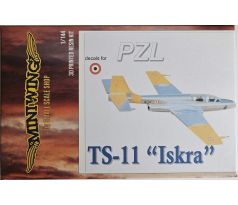
PZL TS-11 "ISKRA" Indian Air Force
3D printed resin model kit
The PZL TS-11 Iskra (English: Spark) is a Polish jet trainer, developed and manufactured by aircraft company PZL- Mielec. It was used by the air forces of Plandand India. It is notable as being the first domestically developed jet aircraft to be produced by Poland, its service for over 50 years as the principal training aircraft of the Polish Air Force. At the time of its retirement in 2021, it was the oldest jet-propelled aircraft still in service in Poland.
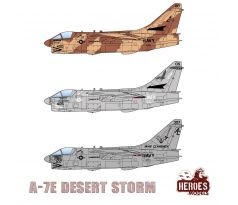
A-7E Desert Storm
Screenprint decals for three planes in 1/144 scale to represent the A-7E Corsair’s II that flew in Desert Storm operation.
LTV A-7E 160552
VA-72 Blue Hawks, USS John F. Kennedy, Iraq 1991
LTV A-7E 160713
VA-46 Clansmen, USS John F. Kennedy, Iraq 1991
LTV A-7E 160286
VA-72 Blue Hawks, USS John F. Kennedy, Iraq 1991