Hunter T.7 (RAF) Conversion Set

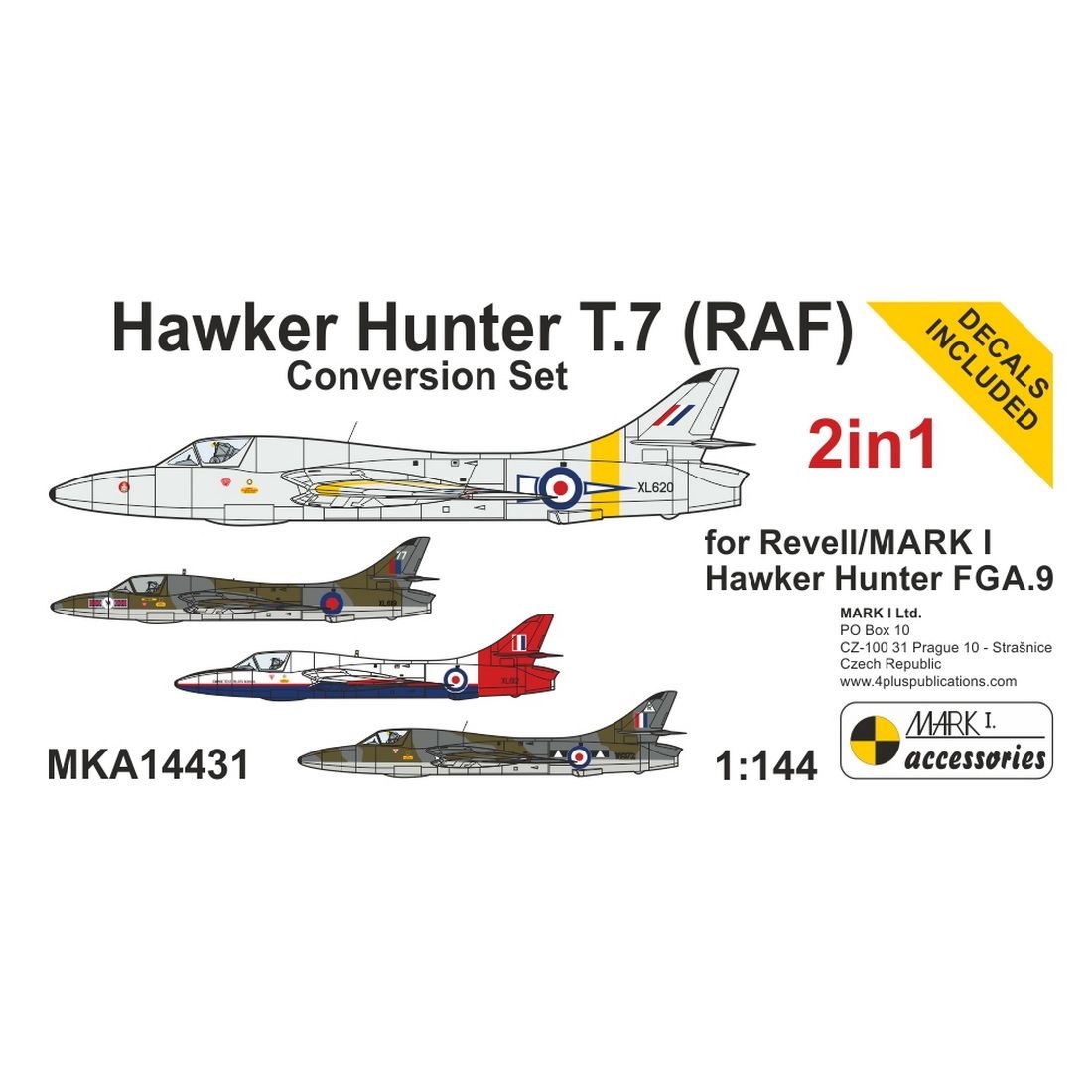

Hunter T.7 (RAF) Conversion Set
Two conversion sets (injection-moulded parts) are included, each containing 14 parts and one clear part (the cockpit canopy).
For modeller’s convenience a display base, made of pasteboard card, depicting tarmac section of the military airport is added.
A comprehensive instruction leaflet and a decal sheet are included.
Colour schemes included in the kit:
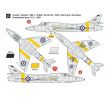
1) Hawker Hunter T Mk.7, XL620, No.66 Sq., RAF, Acklington Air Base, Northumberland, U.K., 1960
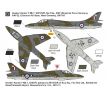
2A) Hawker Hunter T Mk.7, WV372/R, No.2 Sq., RAF (Royal Air Force Germany, RAFG), Gütersloh Air Base, West Germany, 1967-69
2B) Hawker Hunter T Mk.7, G-BXFI, painted as WV372/R of No.2 Sq., Fox-One Ltd., Kemble Air Base/Cotswold Airport, Gloucestershire, U.K., 2001-11
3) Hawker Hunter T Mk.7, XL619, White 77, No.45 Sq., RAF, Wittering Air Base, Cambridgeshire, U.K., acting as an umpire a/c during ‘Exercise Big Click 74ʼ, Leck Air Base, West Germany, August/September 1974
4) Hawker Hunter T Mk.7, XL612, ‘Raspberry Ripple’, Empire Test Pilotsʼ School (ETPS), Royal Aircraft Establishment (RAE), Boscombe Down Air Base, Wiltshire, U.K., 1970-2001
| Ref. No.: | MKA14431 |
| Availability: | IN STOCK |
Hunter T.7 (RAF) Conversion Set
The Hawker Hunter was a British jet fighter developed during the late 1940s and its prototype, the P.1067, was flown in July 1951. Succeeding first-generation jet fighters such as the Meteor and Venom, the first Hunters were introduced to RAF service in 1954.
The Hunter T Mk.7 was a two-seat trainer variant built for the RAF. It had the single seat nose replaced by a side-by-side seating section. Originally based on the F Mk.4 fighter, six aeroplanes were rebuilt and 55 were built anew. The first T Mk.7s entered service in 1958.
It was a two-seat swept wing all-metal monoplane aircraft powered by a R-R Avon turbojet. It featured two wing-root intakes, single jet pipe, upward-opened canopy, ejection seats and tail-mounted brake parachute. The on-board armament of the two-seat Hunter was reduced to one (or two) Aden cannon semi-buried in the fuselage undersurface, while up to four drop tanks could be carried beneath the wings.
The Hunter was one of the RAF’s mainstays from the mid-1950s through the sixties. It became a popular machine in foreign service, being exported to many countries worldwide. Two-seat variants remained in use for training and secondary roles with the RAF until the early 1990s.
Products purchased together with this product
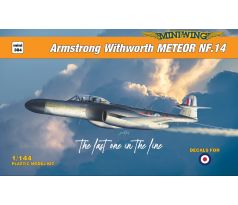
Armstrong Withworth METEOR NF.14
AVAILABLE IN THE 1ST WEEK 2026
British Night FighterPlastic model kit
37 plastic parts + 1 clear plastic part
Decal sheet for 3 color variants
Canopy mask included
History: The Meteor NF.14 Night Fighter was the last major development of a line that started in July 1944, with the first jet aircraft to go into service with the Royal Air Force, and included the F.4, F.8 and T.7. The NF.14 was a two-seat, twin-engined monoplane, powered by two Rolls-Royce Derwent 8 turbojets, each delivering 3,600 lb thrust. The service ceiling was 40,000 feet and the maximum speed was 579 mph. Its range, with ventral and underwing tanks, was approximately 950 miles at altitude.
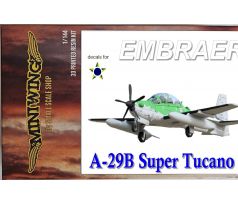
Embraer A-29B SUPER TUCANO
3D printed resin model kit
Brazilian Air Force.
The Embraer EMB 314 Super Tucano (lit. 'Super Toucan'), also named ALX or A-29, is a Brazilian turboprop light attack and counter-insurgency aircraft designed and built by Embraer as a development of the Embraer EMB 312 Tucano. The A-29 Super Tucano carries a wide variety of weapons, including precision-guided munitions, and was designed to be a low-cost system operated in low-threat environments.
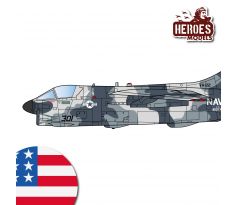
A-7E | VA-22 “Redcocks” US Navy| 1988
One-Shot Decals is our new decals series. Only one subject, a reasonable price, and a catalog always in expansion. Buy only what you need. The package includes the decals and a printed painting scheme with colors suggestion.
ATTENTION! These decals are printed on unique film support. You must trim as close as possible to the decal you will use. New! Now already cut by cutting plotter!
A-7E | VA-22 “Redcocks” US Navy| 1988
Commemorative painting after the operation “Praying Mantis” in the Persian Gulf.
Suggested kit: Heroes Models/F-toys
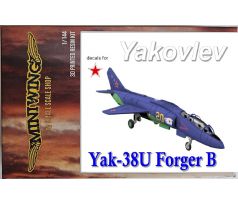
Yakovlev Yak-38U FORGER-B
AVAILABLE FROM MARCH 2026
High quality 3d printed resin kit
The Yakovlev Yak-38U (NATO reporting name: Forger-B) is the two-seat conversion trainer variant of the Soviet Navy's first operational VTOL (Vertical Take-Off and Landing) strike fighter, the Yak-38 Forger.
Design and Development- Two-Seat Configuration: To accommodate a second cockpit for the instructor, the fuselage was significantly enlarged and lengthened to 17.76 meters. This resulted in a distinct, "drooped" nose appearance compared to the single-seat version.
VTOL System: Like the standard model, the Yak-38U used a unique (and often criticized) three-engine arrangement: one R-27V-300 turbojet for main thrust and two dedicated RD-36-35FVR lift engines mounted vertically behind the cockpit.
Safety Features: It was equipped with an automatic ejection system that would fire if one of the engines failed during a vertical phase, or if the aircraft exceeded a certain pitch/roll angle.
Operational Service- Purpose: Its primary role was to train pilots for the difficult task of landing on the moving decks of Kiev-class aircraft carriers.
Production: A total of 38 units were produced between 1975 and 1985.
Users: Served exclusively with the Soviet Naval Aviation and later briefly with the Ukrainian Navy after the collapse of the USSR.

