Westland Wapiti Mk.IIA ‘RAF Service’

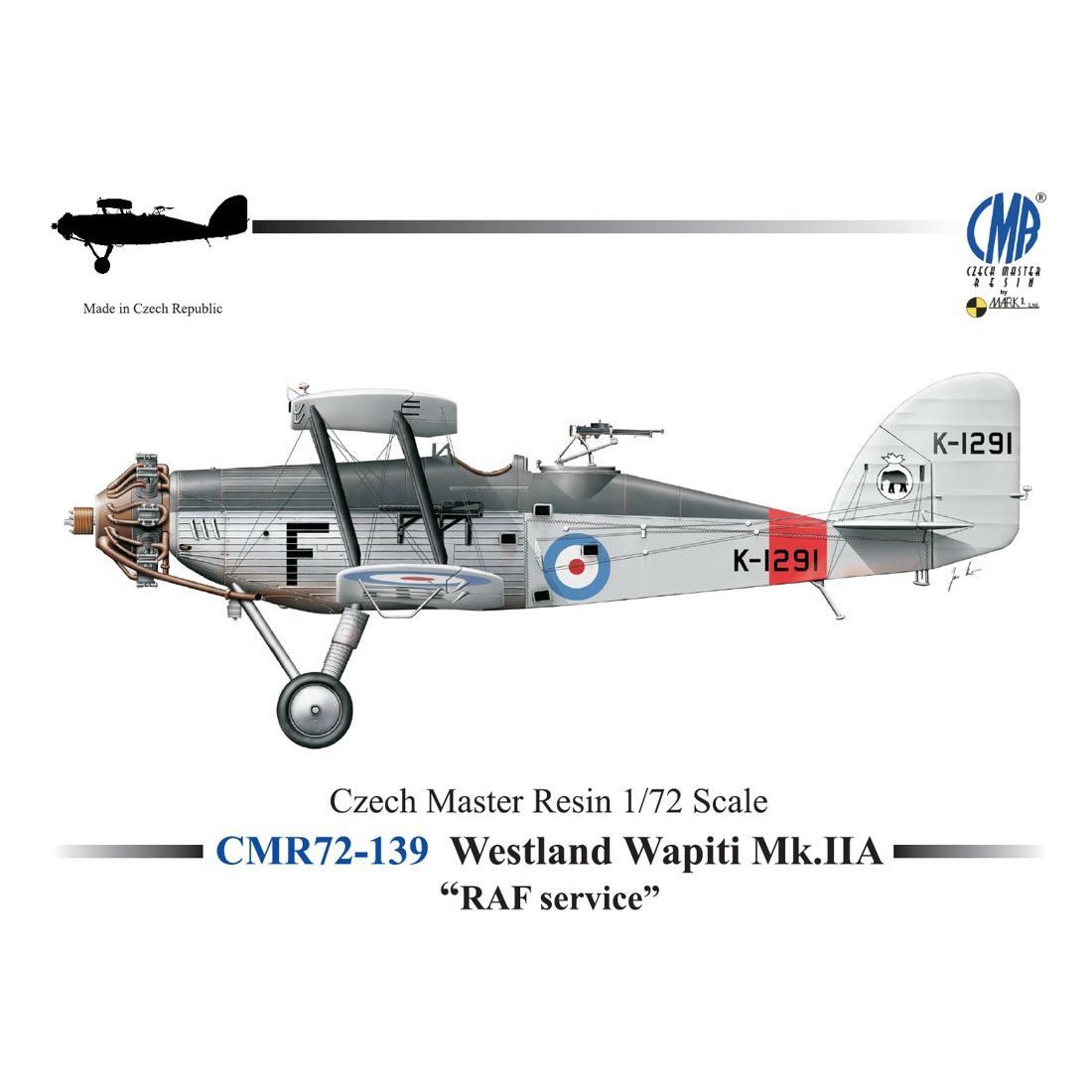

Westland Wapiti Mk.IIA ‘RAF Service’
This full resin kit contains 134 parts, including 59 hardened black resin parts (undercarriage, struts and various details), vacform windshield (a spare set is included for modeller’s convenience) and a comprehensive decal sheet.
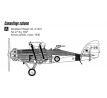
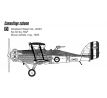
Colour schemes included in the kit:
1) Westland Wapiti Mk.IIA, K1291, No.27 Sq., Kohat airfield, India, 1936
2) Westland Wapiti Mk.IIA, J9403, No.30 Sq., Mosul airfield, Iraq, 1929
3) Westland Wapiti Mk.IIA, K1336, No.607 (County of Durham) Sq. (RAuxAF), Usworth airfield, Durham, U.K., 1935
4) Westland Wapiti Mk.IIA, J9388, No.31 Sq., Quetta airfield, India, 1931-32
5) Westland Wapiti Mk.IIA, K1342, No.601 (County of London) Sq. (RAuxAF), Hendon airfield, London, U.K., 1932
| Ref. No.: | CMR72-139 |
| Availability: | IN STOCK |
Westland Wapiti Mk.IIA ‘RAF Service’
The Westland Wapiti was a British-built two-seat general purpose military biplane of the 1920s. It was used in the Army Co-operation role, as a bomber or reconnaissance aircraft. The prototype flew in March 1927 and the type entered service with the RAF one year later. It was in production until 1932, with a total of 565 aircraft being built. The initial production comprised the wooden fuselage, tail and wings which were replaced by metal structures in the Wapiti Mk.II and IIA. It was a conventional two-bay biplane with tandem open cockpits and a fixed main undercarriage. The forward fuselage was of metal covering, while the rear fuselage was fabric covered. The Wapiti was powered by a Bristol Jupiter radial engine turning two-blade wooden propeller. It was armed with a forward-firing Vickers machine gun and a Lewis gun for the observer, and it could carry up to 580 lb of bombs of various types under the fuselage and wings. It was also fitted with a radio and photographic instruments. The Wapiti equipped twenty squadrons of the RAF, serving both at home and overseas – in India and Iraq. It remained in RAF service until 1940.
Products purchased together with this product
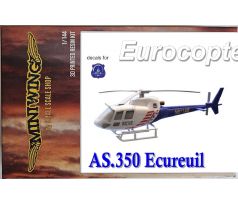
Eurocopter AS.350 ECUREUIL - Washington DC Police department
AVAILABLE DURING MARCH 2026
High quality 3D resin printed kit
The Airbus AS350 Écureuil (Squirrel), also marketed as the AStar in North America, is one of the most successful and versatile light utility helicopters in aviation history.
Feature Specification (Standard AS350 B3 / H125)Engine 1 × Safran (Turbomeca) Arriel 2D (approx. 848-952 shp)Capacity 1 Pilot + 5 to 6 PassengersMax Speed 287 km/h (155 knots)Cruise Speed ~245 km/h (132 knots)Range 630 – 660 km (approx. 350-400 miles)
Rotor System 3-blade "Starflex" main rotor head made of composite materials
History and RecordsOrigins: Developed by the French company Aérospatiale to replace the Alouette II, it first flew on June 27, 1974.
Everest World Record: On May 14, 2005, pilot Didier Delsalle landed a standard AS350 B3 on the summit of Mount Everest (8,848 meters), setting a world record for the highest takeoff and landing that remains unbroken.
Evolution: Over the decades, the manufacturer name changed from Aérospatiale to Eurocopter and finally to Airbus Helicopters. Since 2015, the latest version of the AS350 B3e has been rebranded as the Airbus H125.

