Hawker Hunter T.7 (RAF & Export) Conversion Set


Hawker Hunter T.7 (RAF & Export) Conversion Set
Two conversion sets (injection-moulded parts) are included, each containing 14 parts and one clear part (the cockpit canopy). For modeller’s convenience a display base, made of pasteboard card, depicting tarmac section of the military airport is added. A comprehensive instruction leaflet and a decal sheet are included.
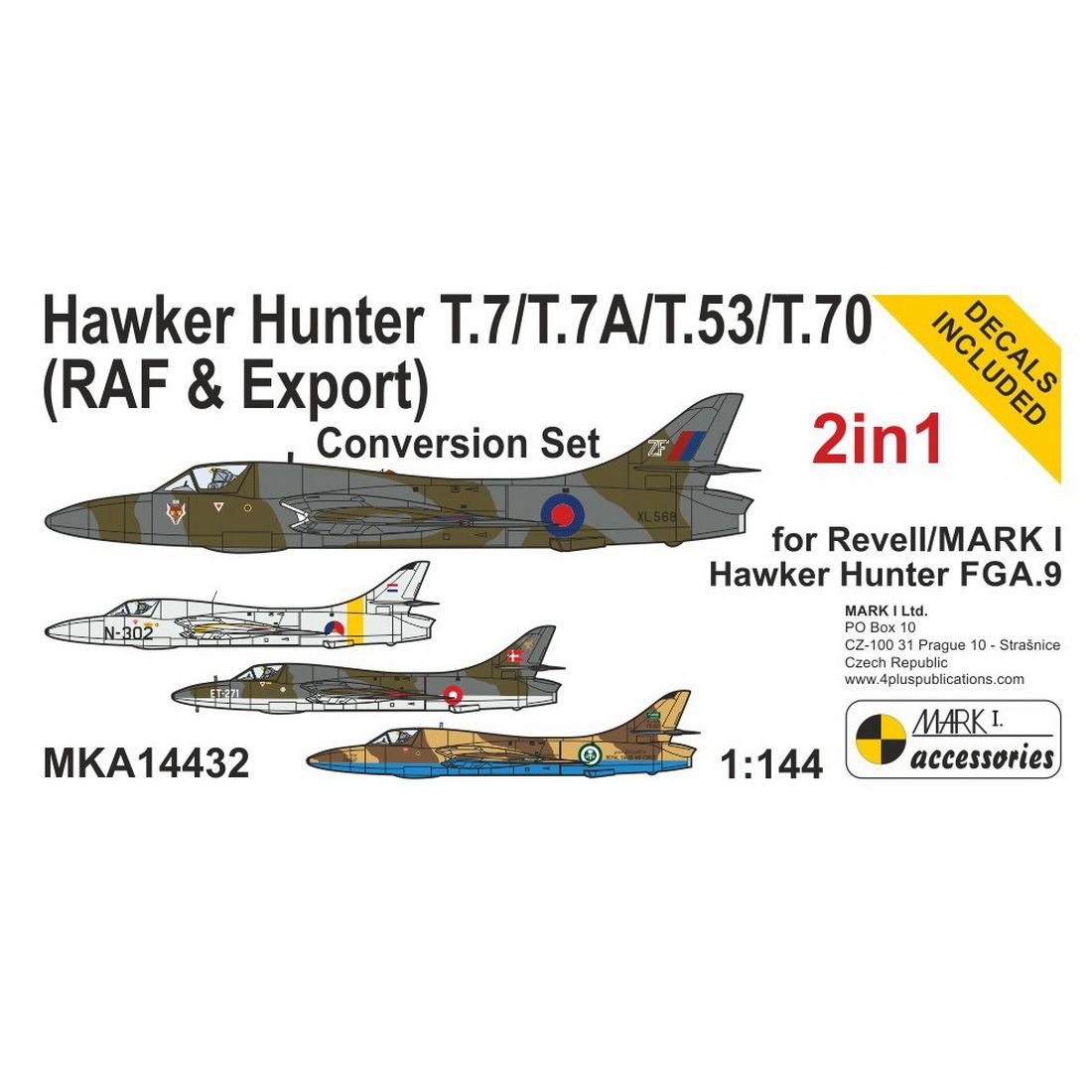
Colour schemes included in the kit:
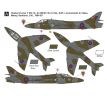
1) Hawker Hunter T Mk.7A, XL568/ZF, No.12 Sq., RAF, Lossiemouth Air Base, Moray, Scotland, U.K., 1984-85
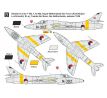
2) Hawker Hunter T Mk.7, N-302, Royal Netherlands Air Force (Koninklijke Luchtmacht, KLu), Twente Air Base, the Netherlands, autumn 1958
3) Hawker Hunter T Mk.53, 53-271, White ET-271, No.724 Sq. (Esk 724), Royal Danish Air Force (Kongelige Danske Flyvevåbnet), Skrydstrup Air Base, Denmark, 1970
4) Hawker Hunter T Mk.70, 70-617 (ex-XL605/G-9-214), No.6 Sq., Royal Saudi Air Force (Al-Quwwat al-Jawwiya al-Malakiya al-Saʻudiya), Taif Air Base, Saudi Arabia, late 1960s/early 1970s
| Ref. No.: | MKA14432 |
| Availability: | IN STOCK |
Hawker Hunter T.7 (RAF & Export) Conversion Set
The Hawker Hunter was a British jet fighter developed during the late 1940s and its prototype, the P.1067, was flown in July 1951. Succeeding first-generation jet fighters such as the Meteor and Venom, the first Hunters were introduced to RAF service in 1954.
The Hunter T Mk.7 was a two-seat trainer variant built for the RAF. It had the single seat nose replaced by a side-by-side seating section. Originally based on the F Mk.4 fighter, six aeroplanes were rebuilt and 55 were built anew. The first T Mk.7s entered service in 1958.
It was a two-seat swept wing all-metal monoplane aircraft powered by a R-R Avon turbojet. It featured two wing-root intakes, single jet pipe, upward-opened canopy, ejection seats and tail-mounted brake parachute. The on-board armament of the two-seat Hunter was reduced to one (or two) Aden cannon semi-buried in the fuselage undersurface, while up to four drop tanks could be carried beneath the wings.
The Hunter was one of the RAF’s mainstays from the mid-1950s through the sixties. It became a popular machine in foreign service, being exported to many countries worldwide. Two-seat variants remained in use for training and secondary roles with the RAF until the early 1990s.

